Showing posts with label UG Field Trip. Show all posts

Thursday, October 30, 2025

Site Visits in October 2025

Starting with a field trip to our beautiful city in September for the new undergraduate students in Construction, there have been some great site visits this month (thanks to Max Muncaster and Jeremy Price for the photos)...

Oxford fieldtrip for the new undergraduate students

Next stop...Blackbird Leys. A group of first year students in Construction made a site visit to a housing project in Blackbird Leys on 22 October. The trip was lead (and photographed) by Jeremy Price and Max Muncaster and hosted by Hill Group.


And back on campus for a site visit on 23 October...thanks to Steve Vaux, Operations Director at Morgan Sindall for arranging for our first year students taking the module 'Introduction to Construction Practice' to visit the current project to fit out Block C for Clive Booth Student Village. The focus of the visit was to look at the way Morgan Sindall are managing quality and managing health and safety.


And finally, the 4th year students went on a site visit on 21 October to Cherwell College to see the additional floor being added to the student accommodation at the college. Thanks to our part-time student (Sam Bourke) who works for Savvy Construction for organising. The visit was for students taking the module in construction project management - specifically to look at construction sequence, change control and risk management.


For more information on our undergraduate courses in Construction, take a look here:


Tuesday, February 11, 2025

Development Projects - Field Trip to London

At 10 Gresham Street

A group of first year students in Construction went on a field trip to London on 7 February. The trip was hosted by Mace and focused on sustainability in construction and development. Emphasis on sustainability is part of a wider approach being adopted by modern construction organisations to prioritise measurable success in ESG (Environmental, Social and Governance). Companies like Mace are now managing their projects in ways where the impact on the environment together with impact on society can be measured. Success in ESG is becoming essential for society where individual health and wellbeing, respect for cultural heritage and sustainable business can flourish. Thanks to Max Muncaster for the photos.

The students visited 3 projects: Panorama St Paul's (81 Newgate Street) where the redevelopment of former BT offices to increase net internal area (NIA) apply circular economy principles...


10 Gresham Street- a phased retrofit, including an additional floor and wellness upgrade of existing offices while still partially occupied, again with circular economy principles applied...


And finally, Peninsula Gardens a development of new apartments in tower blocks (up to 35 storeys high) as part of the urban village being developed on the Greenwich Peninsula. These apartment blocks overlook the River Thames and are constructed with off-site manufactured kit of parts.


Take a look at the School of the Built Environment and the courses we offer here and link to our undergraduate courses in Construction here:

Friday, March 24, 2023

Field Trip to Belgium and The Netherlands January 2023

Group photo in Antwerp (Museum Aan de Stroom) at the start of the field trip

A group of second year students from the undergraduate courses in Construction went on a field trip to Belgium and The Netherlands at the end of January 2023. Words by Lindsey Harrison and photos by Collin Kalayil Roy...

Day 1: After leaving Oxford Brookes at 4.30am the first stop was Antwerp in Belgium  where we stopped at the old port area. The new port is the largest in Europe and is a few miles out of town and the old port area has been developed for leisure. The centrepiece is the MAS Museum Aan de Stroom which was amazing to see. We spent time walking through it and going to the rooftop viewing area. We were able to see close up the innovative construction methods which allow for the corrugated glass panels to withstand the forces exerted on them, and to see also the extent of the detailing on the building, for example the hand motif used throughout which refers back to the myth about the founding of Antwerp.

The old port in Antwerp


Floating homes at Ijburg


Walking through Ijburg


Day 2: On our first full day in Amsterdam, we visited the Ijburg area where land has been created by making artificial islands from material dredged from the sea. Once the ground has stabilised the islands are built on. Apart from the incredible vision of this project and the very complex engineering challenges which are impressive enough in themselves, the other commendable aspect of the development is that it is not just creating residential housing but all the infrastructure has been planned out too so the area has excellent roads, public transport links, bike paths, schools, playparks and so on.
Alongside the islands there are also floating homes which are permanently tethered to the land but float on the water. Again this is an imaginative solution to Amsterdam’s problem of lack of space and abundance of water. It is also an interesting solution to the problems of flooding caused by water levels rising due to climate change. 

Sluishuis - the first floating structure in the Ijburg district. It is a residential building comprising
442 flats with 60% available to rent...


...and up on the roof where there are 2200 m2 of solar panels with an EPC rating of -0.02


In the afternoon we looked at some projects in central Amsterdam. This is an ambitious underground carpark at Ponsteiger which is being constructed underneath a canal. The engineering is complex and the canal has been emptied to allow construction to take place. All the materials are delivered by electric powered barge to cut down on construction traffic and reduce emissions. The crane is on runners so it can take the deliveries off the barge and put them down where they are needed on the site. The local residents had been opposed to this project and cutting construction traffic had been one way to address some of their concerns.

Carpark construction at Ponsteiger


Rotterdam where it was freezing cold...


Day 3: Rotterdam. Where we explored some of its distinctive architecture - cube homes built in the 1960s and striking and individual skyscrapers. The planners in Rotterdam seem very willing to allow new and innovative architecture. It has fewer heritage buildings than Amsterdam as it was badly bombed during the war and so it is free to reinvent itself, which it does with imagination and flair.


This is a floating office in Rotterdam Harbour, Rijnhaven, which is entirely off grid. One of the architects who works there gave us a tour and explained the main features of it. It uses the water in the harbour to regulate passive heating and cooling.


The floating office...


...and the tour

The Deloitte Building

At the end of our Rotterdam visit we were given a very interesting tour of the Deloitte Building by the facilities management team. We were very well looked after by them and by the end of the tour we had some real insights into what sort of problems an FM team faces every day in an effort to keep a building that size functioning.

Day 4:  And we visited the Zuid district of Amsterdam. Zuid is an area to the south of the city which is undergoing a very lengthy and extensive redevelopment. The hope is to place many of the businesses there which will ease the pressure on central Amsterdam both in terms of office space and traffic flow. Excellent public transport links have been planned and a range of building styles used to create interest. Emphasis has been placed on setting up a mixed community so that it has a sense of place rather than becoming a faceless business district.

The city planner, Paco Bunnik, gave us an interesting talk in the planners’ offices to explain the rationale behind this development and then a tour of some of the projects which have already been built.


Then we visited a Zuid project called The Valley, it is supposed to resemble a street but a vertical one. The architecture and construction quality were outstanding...


In the afternoon of our last day we were free to explore Amsterdam starting in the museum district with a visit to the Stedljik Museum of Modern Art.


Day 5: Return to Oxford via the Rotterdam Port Visitor Centre where the students had a go on a VR game to load up a container ship...


For more information about the courses at Oxford Brookes, take a look here:

Monday, February 14, 2022

A first for a UK university - and it's happening at Oxford Brookes

Oxford Brookes is set to become the UK’s first university to retrofit pioneering new heating technology on campus - the first UK University to have an operational deep borehole system.

The technology reduces the environmental impact of the existing heating and cooling system, and Oxford Brookes will become the first UK university with an operational deep borehole system. The concept involves the capture of waste energy from cooling, storing it in the earth for later use as heat. The development will involve the drilling of fourteen boreholes to a depth of approximately 220m. Piping from the boreholes will connect to a flowline, trenched underground the Headington Campus’ Energy Centre. The system replaces the use of fossil fuels and reduces energy consumption across both cooling and heating processes. Requiring significantly less space than traditional ground source heating it can be retrofitted to existing sites, such as the Energy Centre in the University’s John Henry Brookes Building (words taken from the Oxford Brookes website - read the full article here).

A group of 4th year students who are studying facilities management were invited to go and take a look at the developments (thanks to Max Muncaster for the photos):


ECS Carbon Reduction Lead, Gavin Hodgson explaining to the students where the ground source heat pumps will be installed

ECS showing the students the site prepared for drilling geothermal bore holes on Headington Campus

ECS geothermal project - being shown the steel casings to be used for the 200m deep bore holes


For more information about our undergraduate courses in construction management, take a look here.


Friday, February 4, 2022

Field Trip to Manchester and Sheffield - January 2022

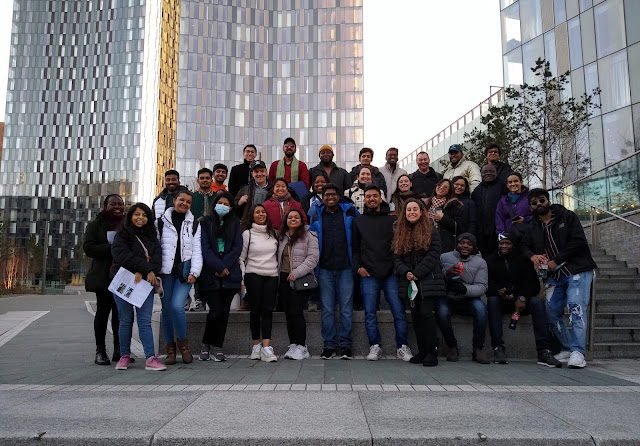
A group of postgraduate and undergraduate students from across the five MSc and the three BSc programmes in the School of the Built Environment went on a field trip from 17 - 20 January 2022. They visited Manchester and Sheffield looking at urban developments in the cities and they attended presentations from contractors involved in projects in Salford. If you want to find out more about development in Manchester and Sheffield, take a look here:

The key developments taking place in Manchester
Developments to look out for in Manchester
The heart of Sheffield (includes a video of the new city centre development)

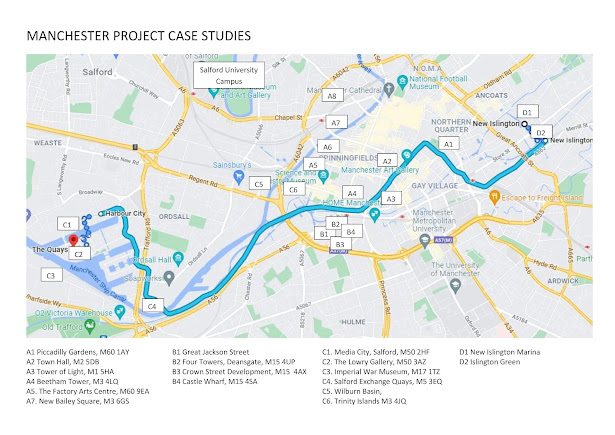
Thanks to Adrian Robinson, Max Muncaster and all the students for taking the photos. Let's start with Manchester and a map of the sites visited. 


And now the photos of Day 1 in Manchester:

Thanks to Yusuf Surer for the fantastic architectural photos of Deansgate Square


Manchester Trams - and the future

Find out more: Manchester Civic Quarter Heat Network 


New Bailey - find out more


Day 2 was spent in Sheffield:


What's this? Find out more about the award winning Concourse at the University of Sheffield


And then it was back to Manchester for day 3 and day 4 (which turned out to be mostly about football):

Europe's biggest living wall at the Eden development

Find out more about The Northlight


New Islington - developed over the last 20 years by Urban Splash


City or United? Find out more about the history of these two iconic Manchester clubs


If you're interested in finding out more about the degree courses we offer in Construction at Oxford Brookes, take a look here:

Postgraduate courses in Construction

Undergraduate courses in Construction